
The Voiced Hunter and the Narrative Heart of Monster Hunter Wilds
Monster Hunter Wilds’ voiced hunter and scholarly handler create a partnership that deepens narrative without sacrificing the series’ soul.
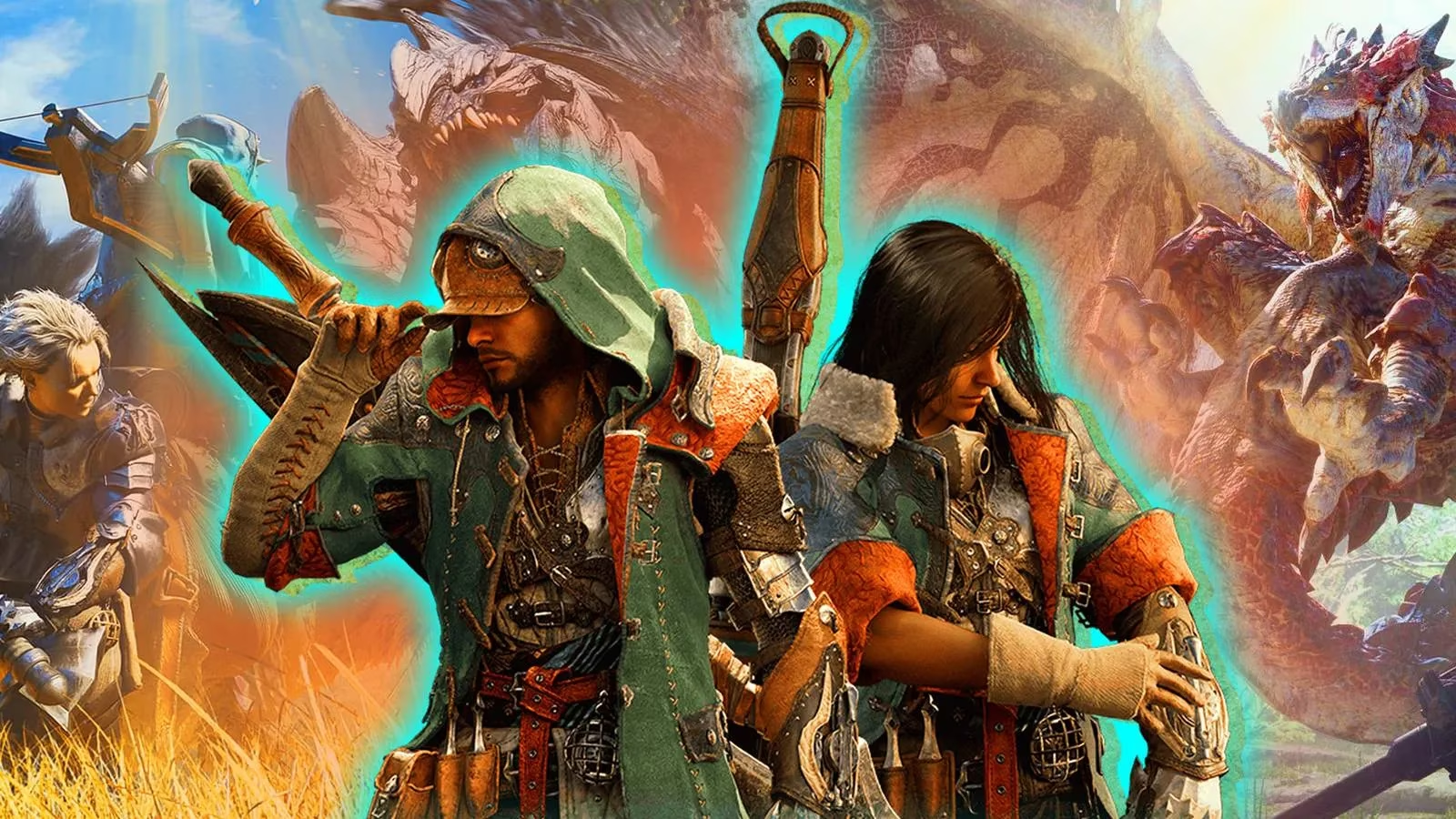
For years, the hunter in the Monster Hunter series remained a silent silhouette, a vessel for player action whose voice was conveyed through grunts, nods, and the satisfying clang of a Great Sword. With Monster Hunter Wilds, that tradition was deliberately broken, and what emerged was not a loss of identity but a profound rebalancing—like a master blacksmith adding a precisely calibrated counterweight to a blade, making it both more agile and more forceful. The shift to a fully voiced protagonist, introduced in 2025, reshaped the narrative landscape of the franchise, turning what was once a functional backdrop into a tapestry woven with personal stakes and camaraderie.
Much of the initial reaction to the voiced protagonist mirrored a craftsman’s skepticism toward a new alloy: it was unfamiliar and threatened to dilute the pure, gameplay-first essence. Yet, the execution in Wilds proved that the change operated not as a drastic overhaul but as a subtle undercurrent that carved deeper channels through already established terrain. By giving the hunter a voice, the game did not abandon player agency; instead, it offered a careful duet between scripted characterization and customizable expression. Optional dialogue branches allowed the protagonist to probe the histories of companions like Gemma, the sole Smithy of the expedition, turning conversations into layered excavations of backstory. These choice-driven exchanges functioned as tiny turnstiles, each click granting a slightly different passage into the world’s living ecology.
A pivotal innovation was the redefinition of the hunter’s origin. Rather than yet another amnesiac recruit stumbling into a new village, the protagonist of Wilds arrived as a seasoned veteran, an experienced monster hunter tasked with a high-stakes expedition into the Forbidden Lands. This veteran status acted like a keystone in an arch, redistributing the weight of every interaction. Allies regarded the hunter not with cautious instruction but with earned trust, altering the story’s dynamics from mentorship to partnership. For players who had journeyed through earlier titles, this ambiguous yet storied past became a seamless thread connecting their personal Monster Hunter history to the new narrative.
The handler, Alma, emerged as more than a quest-giver; she became an analytical counterpart, a mobile repository of ecological insight who followed the hunter as both shadow and guardian. Unlike previous handlers whose presence could sometimes feel intrusive, Alma’s companionship operated like a well-oiled lantern—illuminating the path without commanding where to step. The voiced hunter amplified this partnership, transforming hunts into dialogues rather than monologues. Together, hunter and handler, alongside the ever-present Palico, formed a trinity of competence, their shared objective binding them into a dynamic team that felt more like a found family than a contractual assembly.
The integration of guild authorization within the narrative further sculpted the hunter’s image. Alma’s role as the gatekeeper of official permission turned every quest into a controlled release of power, suggesting that the hunter was less a rookie and more a force of nature held in check by bureaucratic threads. The coolest cinematic moments were not just exhibitions of skill but declarations of restrained might, where the hunter’s voiced commands during combat became a bridge between the player’s intent and the character’s established competence. This design decision acted as a second, subtler voice—the unspoken authority that resonated behind every well-aimed strike.
While concerns persisted that a voiced protagonist might erode the series’ charm, Wilds demonstrated an unexpected mastery of tonal balance. The hunter’s dialogue never overwhelmed the player’s sense of self, functioning instead like the fine print of a map—present, informative, but never obscuring the territory. Even in moments of levity or tension, the voice acting remained flexible, capable of delivering dry humor during a meal or gravitas during a confrontation with an Elder Dragon. This range allowed the protagonist to stand as one of Wilds’ best characters, no longer a blank slate but a prism refracting the player’s decisions through a distinct personality.
Looking into 2026, the narrative framework laid by the voiced hunter has blossomed through post-launch updates and expansions. The unresolved mysteries surrounding the artificial elder dragon Zoh Shia and the lingering shadow of Fatalis have become fertile ground for sequential hunts. The inclusion of a rumored collaboration with Final Fantasy XIV, bringing Bahamut as a multi-phase siege encounter, has already exceeded the scale of previous crossovers. These updates do not merely add monsters; they extend the hunter’s legend, presenting threats that match the protagonist’s veteran stature. The potential introduction of guardian variants for legacy monsters and the full realization of Zoh Shia’s form promise to push the story into territory where the hunter’s voice will be essential—not just as a narrative tool, but as the emotional anchor for battles that challenge the very definition of calamity. The hunter, once a silent witness, now speaks as the herald of a series unafraid to let its heart roar alongside its weapons.
Comments