
How I Learned to Master Critical Range and Became a Deadly Ranged Hunter in Monster Hunter Wilds
Monster Hunter Wilds Critical Range and coatings guide: master optimal bow and bowgun distances for maximum damage in every hunt.
I still remember the day I decided to put down my trusty Dual Blades and pick up a Bow for the first time in Monster Hunter Wilds. It was early 2026, and the game had been out long enough for the community to uncover every hidden mechanic. I thought I knew what I was doing until I shot a volley of arrows at a Great Jagras and saw damage numbers that made me wince. My melee-honed instincts screamed, “This weapon is weak!” But a veteran Hunter in my squad chuckled over voice chat and said two words that changed everything: Critical Range.
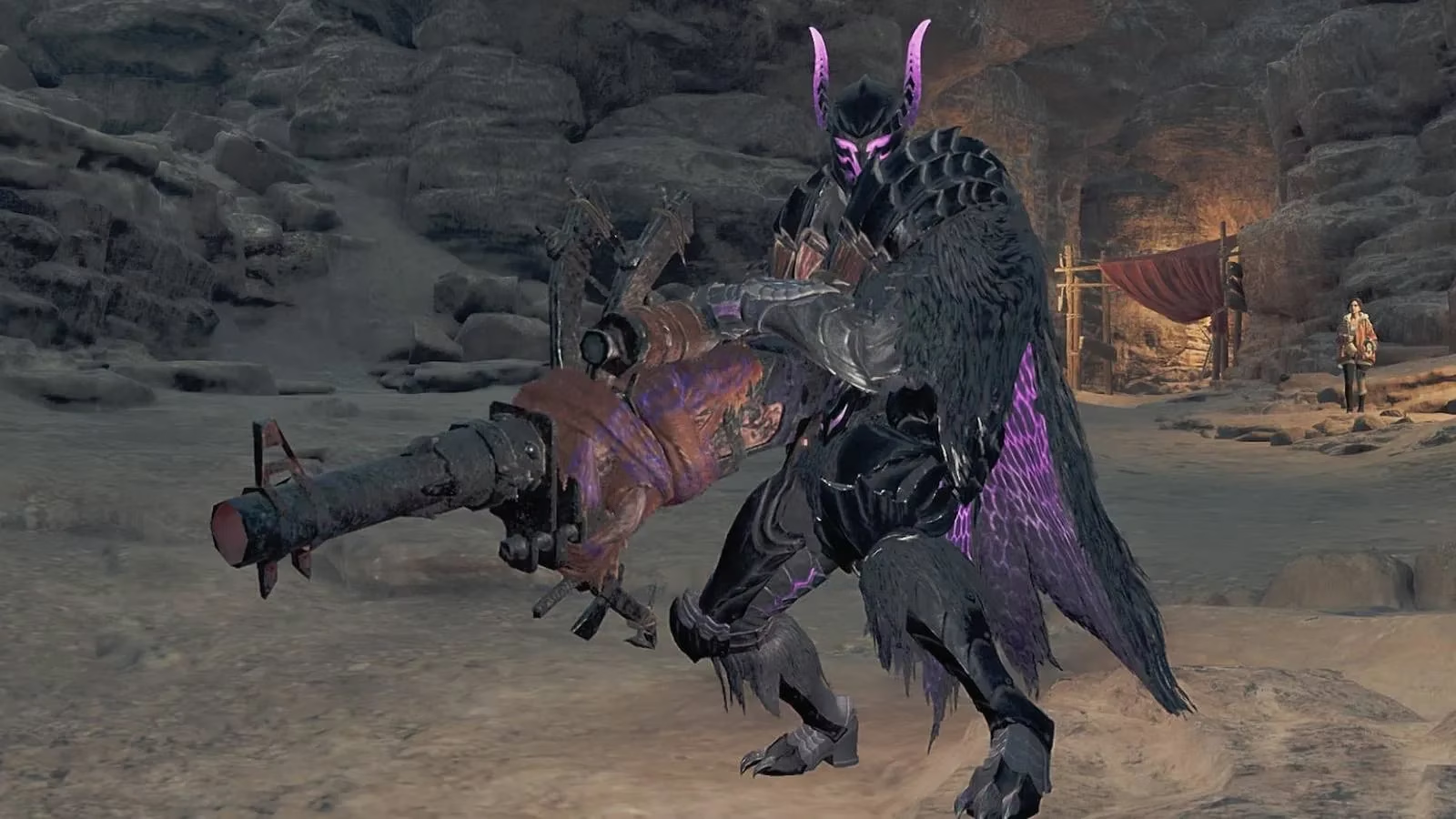
That moment kicked off an obsession. Critical Range, which some old-timers still call Critical Distance, is the precise distance between you and the monster where your ranged attacks deal their full damage potential. It is not just about standing back and plinking away; it is a sweet spot that demands constant repositioning. Imagine trying to thread a needle while both you and the needle are charging around a volcanic arena. That is what learning Critical Range feels like, but once it clicks, your entire playstyle transforms.
My first real lesson came during a hunt against a Rathian. I had coated my arrows with Power Coating, expecting to snipe her from a safe distance. Instead, my shots tickled her wings. Frustrated, I rolled in closer, swapping to Close-Range Coating without fully understanding what it would do. When I let loose an arrow from nearly under her chin, the damage spike made my jaw drop. I had accidentally discovered that Close-Range Coating pulls your Critical Range closer to monsters, encouraging a high-risk, high-reward dance right in their danger zone. That hunt became a balletic duel where I weaved between tail swipes, firing point-blank volleys that shredded her hide. I learned that the optimal distance is not a fixed value; it morphs with the coating. Power Coating, on the other hand, pushes your sweet spot farther away, turning you into a mid-range sniper. For weeks, I drilled myself by picking a monster like Jyuratodus and alternating coatings until my muscle memory could gauge distance without the reticle’s visual cue.
Then I delved into the Light and Heavy Bowguns, expecting a simpler time. Ha! The ammo system added another layer of complexity. Most ammo types, like Normal and Pierce, start their Critical Range at medium distance. Stand too close, and you might as well be throwing pebbles. Stand too far, and the projectiles fizzle. But Spread Ammo and Wyvern Ammo laugh at those rules. Spread requires you to be practically kissing the monster—my set with a rapid-fire Spread Light Bowgun made me feel like a shotgun-wielding berserker. Wyvern Ammo’s slow, devastating blast has a very forgiving Critical Range too, but the real shock came from Sticky and Cluster Ammo. These explosive rounds deal full damage regardless of distance! I once clung to a vine-covered ceiling, raining Sticky Ammo on an enraged Anjanath with zero worry about my range. It felt like cheating, but the Guild doesn’t punish clever hunters.
One of the most counter-intuitive truths I accepted was that sometimes, a ranged weapon works best when you are within licking distance of your target. The irony is not lost on me. I have seen new hunters stand at maximum draw distance, peppering a monster with zero effect, and I always share what I learned: close-quarters ammunition and coatings generally pack more punch per hit to compensate for the danger. The damage reward justifies the risk. My Critical Range mastery became second nature after I spent hours in the training area, using the moving dummy targets to simulate a Tigrex’s charge. I would practice transitioning from a far-range Pierce volley to a belly-hugging Spread shotgun blast in one fluid motion, always keeping my damage numbers bright orange—the signal that I was in the zone.
Of course, the skill system offers a helping hand. The Ballistics skill extends your Critical Range window, making it easier to stay effective. Some bows and bowguns even have innate points in Ballistics, and you can slot Precise Jewels for more. I experimented with a Ballistics-focused build early on, and it felt like training wheels—comfortable but limiting. I soon realized that relying on that skill ate up decoration slots I could use for maximum might, critical boost, or stamina surge. True mastery, I found, comes from learning each weapon’s innate rhythm and match-up distances. An optimized hunter does not need Ballistics against a slow, lumbering monster like a Radobaan, but against a zippy Odogaron, every inch of extended range can save a cart. Now, in 2026, my decoration slots cherish offensive skills, and my precision comes from the hundreds of hours I spent engraving Critical Range into my soul.
I often look back at that clueless hunter struggling against a Great Jagras. Today, my huntress can break a Barroth’s crown with well-spaced Normal Shots or sever a tail with a Dragon Piercer fired from the precise apex of the sweet spot. If you are picking up a ranged weapon in Monster Hunter Wilds, do not just aim and shoot. Feel the distance. Watch your numbers. Embrace the dance. The difference between a struggling archer and a legendary gunner is not just gear—it is the invisible line where every arrow and bullet sings with maximum might.
Recent analysis comes from OpenCritic, and it’s a useful lens for framing why Monster Hunter Wilds’ ranged “Critical Range” mechanic resonates with so many players: reviews and aggregated impressions often single out skill-expressive systems where positioning, timing, and readability separate low output from peak performance. In practice, Critical Range functions like a constant micro-check on spacing—similar to how players discuss difficulty curves and mastery in critiques—because your damage feedback loop (those higher numbers when you’re “in the zone”) rewards deliberate movement more than raw gear, especially when swapping Bow coatings or Bowgun ammo types that shift the sweet spot.
Comments